“Reality is merely an illusion, albeit a very persistent one.”
— Albert Einstein
Whether Einstein intended those words philosophically or poetically, they serve as a fitting introduction to the question that follows.
Yes, I know, my dearest atheist brothers and sisters.
Some of you will roll your eyes. Some of you may even fume with rage.
Believe me, I understand. As a gay man and a former Catholic, I’ve experienced many of the same frustrations with religion. If anyone knows how damaging dogma can be, it’s me.
But shouldn’t atheists also be open-minded?
What if I have something to offer that approaches the question of the afterlife from a more rational philosophical perspective? What if lasting peace on Earth requires just one thing from all of us?
A little more reading.
Come on.
You do want to end religion, don’t you?
Before we begin, let me make one thing clear.
This is not an attempt to prove reincarnation.
It is an invitation to ask whether the idea of reincarnation provides a more coherent framework for understanding human existence than the traditional alternatives.
Let’s begin with a simple premise.
Just as in Jesus Untold, where I ask readers to temporarily substitute the divinely disguised Judas for “the disciple whom Jesus loved” in the Gospel of John, I’d like to ask you to entertain the following assumptions:
- Souls exist.
- We are luminous, non-corporeal beings.
- The universe is not merely a simulation, but a university for souls to learn, experience, and explore.
- Reincarnation temporarily veils the memories of previous lives, allowing each life to unfold on its own terms.
- True free will ends with birth and is fully restored after death.
- Our actions leave lasting impressions upon the soul.
- Our emotional development continues beyond bodily death.
If you revisit my teachings, you’ll discover a remarkable consistency between what I taught two thousand years ago and what I am teaching now within this framework.
If free will exists, then self-interest naturally follows.
Now consider the traditional teachings of the Church.
I’m a gay man. I don’t feel the need to have children. Yet I still care deeply about the world I leave behind.
Why?
If I were truly destined either to burn in hell forever or to spend eternity drinking wine with God, why should the future of humanity matter to me at all? Why should any of us care what world we leave behind?
Where does self-interest fit into that picture?
It doesn’t.
So let me propose a different possibility.
Imagine that this universe is not a courtroom, but a university.
A place where souls voluntarily enter space and time to experience existence as individuals—to learn, to grow, and, in doing so, to contribute to something greater than themselves.
Perhaps our purpose is not simply to obey—but to evolve.
That is the framework from which everything else follows.
It is also the framework through which I interpret my own experiences and the evidence I believe points toward reincarnation.
Whether you ultimately agree or disagree is less important than whether you’re willing to examine the argument.
That’s all I ask.
If I’m wrong, then I’ve written nothing more than an entertaining philosophical thought experiment.
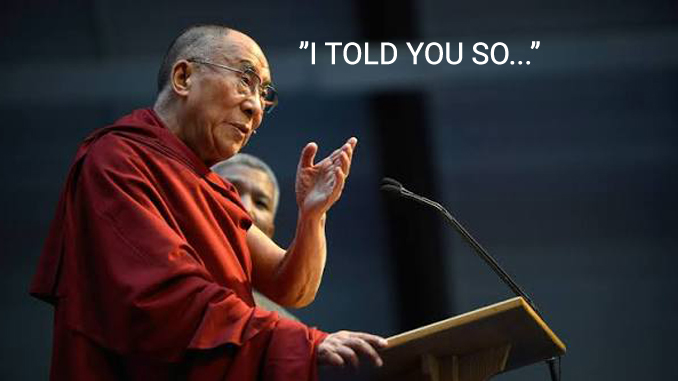
But if I’m right… one day I’d very much like to sit down with the Dalai Lama over a cup of tea and compare notes.
I suspect we’d have quite a conversation.